Example and demo gallery
Use this page to choose the shortest runnable SchemaRouter path for the stack you already have. Examples are either offline deterministic or explicitly marked as live/pinned provider evidence.
Start from your existing stack
| You have | Example | What it demonstrates |
|---|---|---|
| Provider name | provider-first guide | provider identity -> safe usable access methods |
| Python function | typed callable | typed local discovery + execution |
| SDK/client object | SDK-bound demo | explicit contract around opaque trusted runtime state |
| Many tools | context reduction | full catalog versus bounded Top-K retrieval |
| Multiple providers | mixed-provider demo | complementary semantic-field coverage |
| MCP stdio | stdio quickstart | real MCP subprocess discovery and execution |
| MCP Streamable HTTP | reference smoke | real SDK HTTP transport against a pinned server |
| OpenAPI URL | live OpenAPI quickstart | public provider discovery and execution |
| LangChain | LangChain quickstart | StructuredTool bridge |
| LangGraph | LangGraph quickstart | SchemaRouter as a graph node |
| LlamaIndex | LlamaIndex quickstart | FunctionTool bridge |
| Persisted registry/traces | inspection dashboard | live inspection + static HTML dashboard |
| Changing provider schema | schema drift demo | conservative compatibility classification |
| Typed execution state | state-aware retrieval | fixed Top-K filtering vs eligible Top-K corrective backfill |
| Large capability registry | graph scalability guide | indexed/incremental graph construction + benchmark |
| Portable graph files | artifacts and snapshots | inspect, validate, migrate versioned capability files |
| Decision observability | decision trace guide | privacy-safe candidate/exclusion/fallback explanation |
The repository-level examples README contains the exact commands, optional extras, expected-output shapes, and evidence classification.
Real-provider paths
The user-facing quickstart uses APIs.guru because it is public, read-only, and needs no key:
Provider-first acceptance additionally exercises Materials Project, Crossref, and Tavily:
python scripts/live_materials_project_provider_smoke.py
python scripts/live_crossref_provider_smoke.py
python scripts/live_tavily_provider_smoke.py
The Materials Project and Crossref paths execute real read-only provider queries. Tavily validates
the auth contract without a secret and executes a real search when TAVILY_API_KEY is configured.
Additional public compatibility examples cover other protocol surfaces:
The GraphQL example uses the Rick and Morty API; the OData example uses the OData.org V4 reference service. Materials-specific live evidence is available through COD OPTIMADE:
Public-provider uptime is external state, so these paths are scheduled/manual compatibility evidence, not mandatory PR gates.
Pinned protocol references
When no stable unauthenticated public provider is appropriate, the repository uses a local reference implementation rather than pretending a fixture is live public evidence.
For MCP stdio:
For MCP Streamable HTTP:
For OpenRPC / JSON-RPC:
Before and after: avoid dumping every schema
Run:
The example constructs a 40-tool registry and reports the serialized size of:
- the complete registered tool catalog;
- a bounded Top-3
CapabilityRetrievalresult.
The bounded payload must be smaller, and the weather route must rank first for a weather query. This is a product demonstration, not a token benchmark: actual model-token measurements remain in the research benchmark suite.
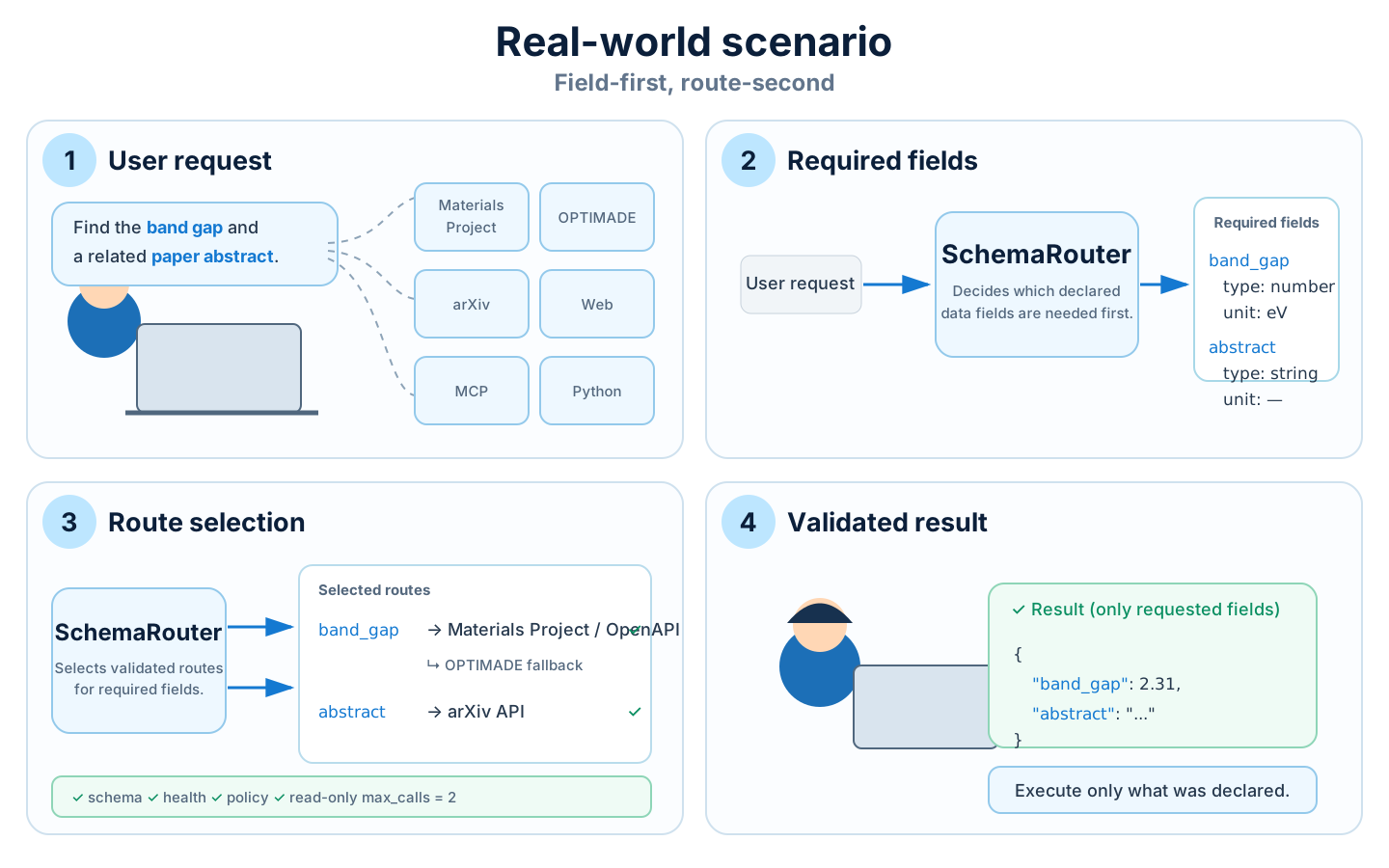
Mixed-provider field-first planning
Run:
One provider declares band_gap; another declares document_abstract. The request asks for both
and allows two calls. SchemaRouter compiles the semantic field need first and then selects
complementary executable routes.
That is the same architecture used when one logical answer requires evidence from heterogeneous providers.
Schema drift and operational inspection
Run the offline drift classifier:
Then use schema drift and compatibility for remote refresh/watch, pending review, explicit accept/reject, and fingerprint behavior.
For runtime observability:
The example writes a static HTML dashboard from a real registry and trace store. The Capability Explorer provides the protocol-neutral Swagger-style view of registered capabilities.
CI and reproducibility
Mandatory CI runs deterministic examples with installed wheel/sdist artifacts. Optional integration jobs execute framework and MCP examples with the relevant extras. Live public providers stay in the separate compatibility workflow so external outages do not block a release.
Post-0.14 infrastructure checks
Provider-first acceptance, state-conditioned retrieval, graph scalability, versioned artifact/snapshot migration, and decision traces are additive infrastructure around the stable execution boundary.
Useful commands:
python scripts/live_materials_project_provider_smoke.py
python scripts/live_crossref_provider_smoke.py
python scripts/live_tavily_provider_smoke.py
python scripts/benchmark_capability_graph.py --sizes 1000,10000,50000
For persisted portable files:
schemarouter artifact inspect graph.json --json
schemarouter artifact migrate graph.json --json
schemarouter snapshot inspect snapshot.json --json
schemarouter snapshot migrate snapshot.json --json
Decision traces and typed-state retrieval are covered by focused guides rather than a second workflow runtime: state-aware retrieval · decision traces.