SchemaRouter 0.7.0
Put a typed execution boundary between agents and tools
SchemaRouter compiles a natural-language request into the smallest declared data-field plan it can justify, chooses a trusted provider/access path that can supply those fields, and validates policy, schema identity, arguments, availability, and raw output before execution is accepted.
-
Minimize
Resolve the semantic data need first. Request only the planned fields upstream when the endpoint explicitly supports server-side projection, then keep only those fields downstream.
-
Compile
Turn OpenAPI, MCP, OPTIMADE, Python callables, or approved documentation into one typed Provider / Access path / Tool / Endpoint / Parameter / Field model.
-
Validate
Reject undeclared arguments, invalid raw outputs, stale schema fingerprints, stale bindings, and unsupported schema assumptions.
-
Enforce
Keep mutation authority, credentials, retries, budgets, approvals, and execution hooks inside trusted local boundaries.
Where it fits
LangChain / LangGraph / LlamaIndex / your orchestrator
                         |
                    SchemaRouter
                         |
          OpenAPI / MCP / OPTIMADE / Python
SchemaRouter is deliberately narrower than an agent framework. The orchestrator owns conversation, graphs, model invocation strategy, memory, checkpoints, and agent loops. SchemaRouter owns the tool-schema execution boundary.
Optional decision backends such as Laya, Ollama, and Jev sit inside the bounded selection step. They receive only finite candidate IDs already produced from the local schema catalog. They do not become orchestrators, cannot invent executable capabilities, and cannot grant execution authority.
Applications that already use GPT, Gemini, Claude, or another hosted model can inject that existing client through SchemaRouter's provider-neutral analyzer or decision-backend callable contracts. SchemaRouter does not require a second local model stack.
Real-world scenario
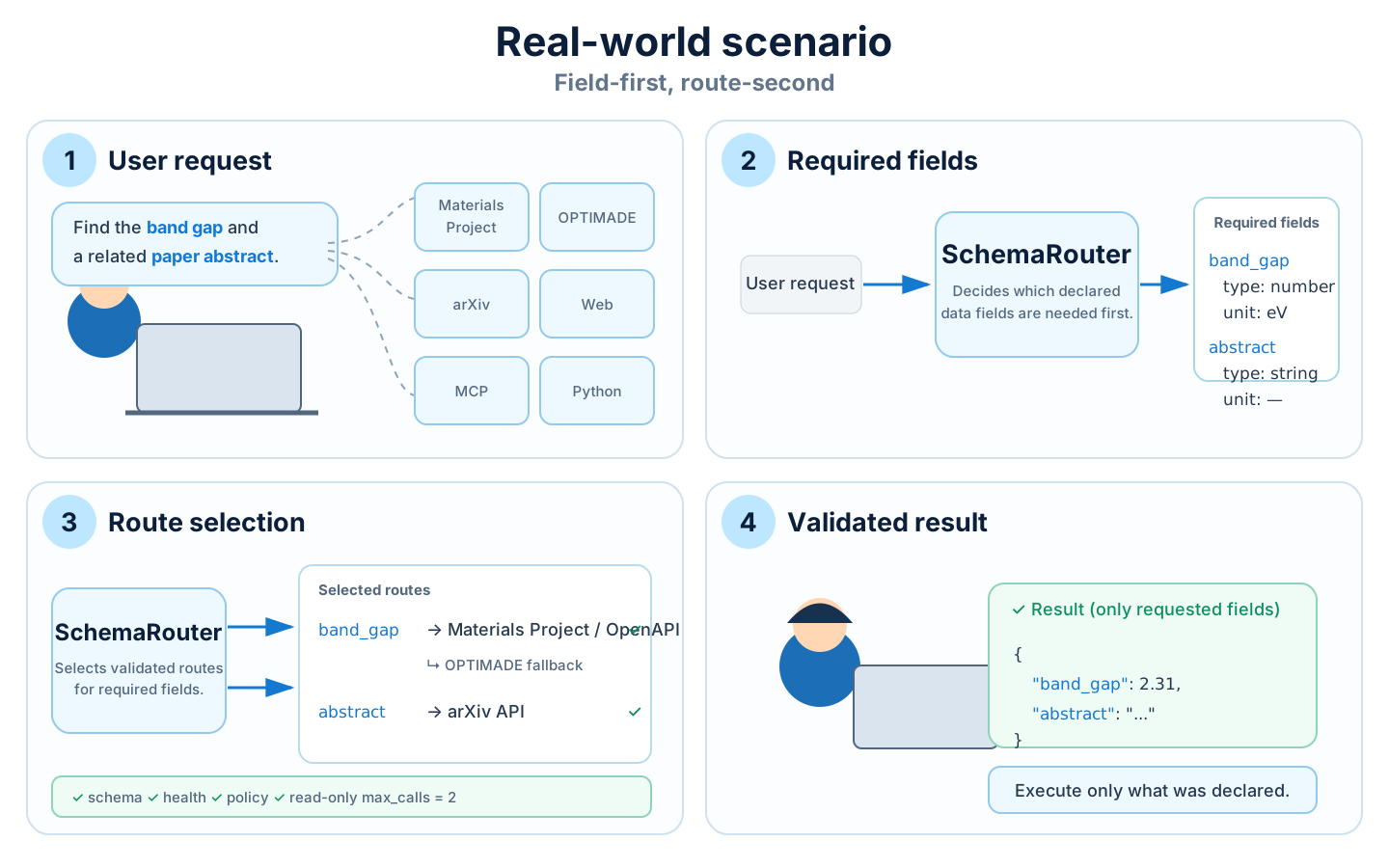
One request can require a union of semantic fields from different providers. SchemaRouter resolves
that field set first, then selects complementary validated routes within the explicit max_calls
bound—for example, Materials Project for band_gap and arXiv for abstract.
Read the field-first execution model → · Read the design principles →
Start in five minutes
from pydantic import BaseModel
from schemarouter import PlanRequest, SchemaRouter, schema_tool


class Weather(BaseModel):
    city: str
    temperature: float


@schema_tool(read_only=True)
def current_weather(city: str) -> Weather:
    return Weather(city=city, temperature=20.5)


router = SchemaRouter()
router.add_callable(current_weather)

result = router.invoke(
    PlanRequest(query="city temperature", arguments={"city": "Seoul"})
)
Connect a capability source
-
Python
Best when the capability is local and typed.
-
OpenAPI
Best when an HTTP API already publishes a machine-readable contract.
-
MCP
Best when tools are already exposed through MCP.
-
OPTIMADE
Best for materials-data providers that expose OPTIMADE.
Human-readable API documentation follows a separate inspect → proposal → explicit approval flow and never becomes executable automatically.
Core runtime guarantees
- unknown tools, endpoints, parameters, and fields do not become executable;
- input and raw output are validated with JSON Schema;
- stale schema fingerprints and invoker bindings fail closed;
- remote metadata and model output cannot grant mutation or destructive authority;
- credentials remain outside model-visible planner arguments;
- retries, wall-clock time, remote calls, response size, and optional cost units can be bounded;
- OpenAPI compatibility gaps are reported instead of silently guessed;
- event payloads remain redacted unless explicitly enabled;
- temporary access failures use finite cooldowns and optional trusted health probes rather than permanent blacklists;
- provider/access fallback never broadens the logical field need compiled from the query.
0.6 focus
Version 0.6 keeps the same execution-boundary scope while adding bounded local/model-assisted
decisions, operational inspection, and a broader fail-closed OpenAPI subset. It adds Laya as an
optional local decision backend, provider-neutral hosted-model reuse, live/SQLite inspection and a
static dashboard, composed-response field discovery, bounded static $id/$anchor resolution,
typed JSON root bodies, nullable normalization, and spec-faithful default parameter serialization.
Read the 0.6.0 release notes →
0.7 focus
Version 0.7.0 keeps SchemaRouter focused on the execution boundary while adding
provider/access fallback, recoverable health state, trusted parameter aliases, and stricter
field-first contracts. Scientific result fields can now carry explicit datatypes, optional unit
metadata and canonical normalization, plus exact trusted qualifiers such as temperature, phase,
orientation, or method.
Those qualifiers can participate in deterministic routing only when the condition is visibly present in the query. They also gate cross-provider fallback exactly. SchemaRouter does not infer scientific equivalence, convert qualifier values, or synthesize measurement context.
Field-first execution and scientific contracts →
Read the 0.7.0 release notes →
Go deeper
-
Execution model
Tool, endpoint, schema identity, planning, and policy.
-
Runtime controls
Retry, execution policy, approvals, hooks, events, traces, and operational inspection.
-
Frameworks and decision backends
LangChain/LangGraph/LlamaIndex integrate above SchemaRouter. Laya/Ollama/Jev are optional bounded decision providers inside it. OpenTelemetry exports telemetry.
-
Architecture
Maturity, compatibility policy, security boundaries, and API reference.